
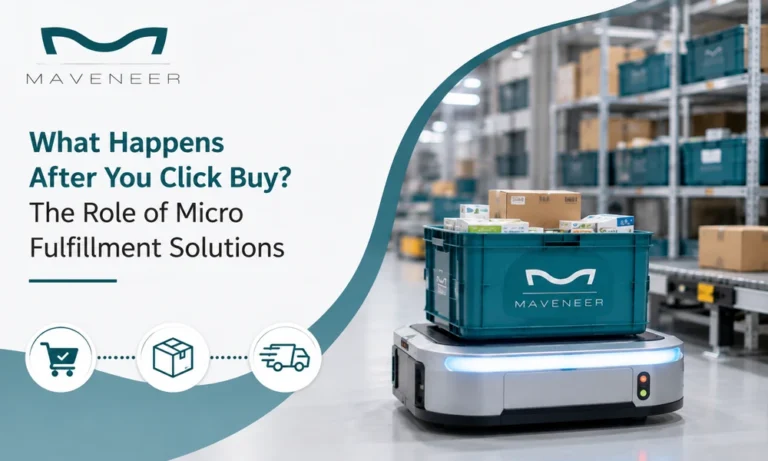
An online order takes seconds from a customer. But what happens next?
The product has to be sourced, picked, packed, sorted, and shipped. When customers are expecting swift delivery, every minute counts. Through micro fulfillment solutions you are moving digital orders from carts to customers and helping in delivery more efficiently.
8:02 AM: The Order Arrives
For example, use cases of customers ordering multiple household products online.
The order goes into the system of the retailer. Rather than shipping the request to a faraway warehouse, it checks supplies in the vicinity. A local dedicated fulfilment center has everything needed on hand.
This simple advantage of location can reduce the travel time required to move the order from one point to its destination.
8:05 AM: Inventory is Located
The next stage is to locate the goods.
The modern micro fulfillment solution has linked inventory software with cycled automated or semi-automated equipment. They assist in tracking where products are located and how the picking should be executed.
This needs accurate inventory data. If an item that the system shows as available turns out to be out of stock, processing can take longer than expected.
8:10 AM: Picking Begins
The necessary pieces are retrieved from storage.
For example, in a traditional warehouse, workers have to walk long distances just to pick up products. A smaller, sit-down fulfillment hub can place high-frequency items in order for faster access.
Automation is another way that can help with repetitive tasks. Robots move bins on demand (depending on the facility), sort products, or bring inventory to workers.
8:18 AM: The Package is Ready
Items are collected after which checking and packing of the items is then done.
Such a stage may seem easy, but it is a question of finding the right accuracy. Wrong items equal returns, customer complaints, and additional shipping costs.
When micro fulfillment solutions are implemented effectively, order information and inventory data play nice together to eliminate unnecessary handling and pick errors.
8:25 AM: The Short Journey Starts
Now the package is out of the facility.
The final leg of the shipment can be shorter because the fulfillment center is near a high-density population area. This would help facilitate faster delivery mechanisms and also assist businesses in handling last-mile transportation better.
The customer may never be the wiser at which location the package was sorted through. All they see is a quicker delivery.
Why Location Changes Fulfillment?
This is the main concept of micro fulfillment solutions.
A business doesn’t always need to speed up long-distance product movement. In some cases, it can cut that distance out altogether by improving delivery.
That can be valuable for:
The Bigger Picture
No one machine or single warehouse builds the foundation of what fast fulfillment is. That hinges on numerous related choices − as to where inventory is placed, what tech is used, how accurate orders are received and filled, staffing levels, and how last-mile delivery is planned.
These all come together around a smaller service area in micro fulfillment solutions. If done right, it allows business to service local demand without relying solely on a massive, remote distribution center.
The smartest thing for companies to do that want better delivery performance may not be to simply hold more products. Or it could be putting the right merchandise closer to people willing to buy it.